
betrayal trauma counseling
Betrayal Trauma Counseling: The Question to Ask Before You Book
By Rising Son Team, Coach led men's program

Photo by Tima Miroshnichenko on Pexels
Photo by Tima Miroshnichenko on Pexels
Betrayal trauma counseling is specialist work for the partner of someone whose secret life has just come out. Not couples counseling, not general talk therapy. Treatment for a specific injury: the one you get when the person you depend on for safety turns out to be the person causing the danger.
Before you book anything, there is one question worth asking, and almost nobody tells partners to ask it. Ask the counselor which model they work from. The answer decides what the next year of your life looks like, and you are entitled to it on a five minute phone call.
For a long time the standard approach treated the partner of a sex addict as a co-addict. The idea was that she had her own parallel disease, that her checking and her questions and her anger were symptoms of codependency, and that her job in treatment was to look at how she had enabled him. Women were handed step work about their own part while the house was still on fire.
The trauma model says something different: what is happening to you is an injury, it was inflicted, and your reactions are what a nervous system does under threat rather than evidence of a character defect. Betrayal trauma theory describes why this particular betrayal hits differently: the person you would normally go to for comfort is the source of the danger, so the two systems that keep you safe end up pointed at each other. That produces symptoms that look a great deal like post-traumatic stress, which is what most partners are actually experiencing.
Most good counselors now work from the trauma model, and the professional body built around it, APSATS, trains and lists specialists in exactly this. The older framing has not disappeared though, and it turns up in general practices, in some faith-adjacent programs, and in any room where someone opens with what your part in this was. If a counselor's first move is your side of the street while you are still shaking, that is the wrong room. You are allowed to leave it.
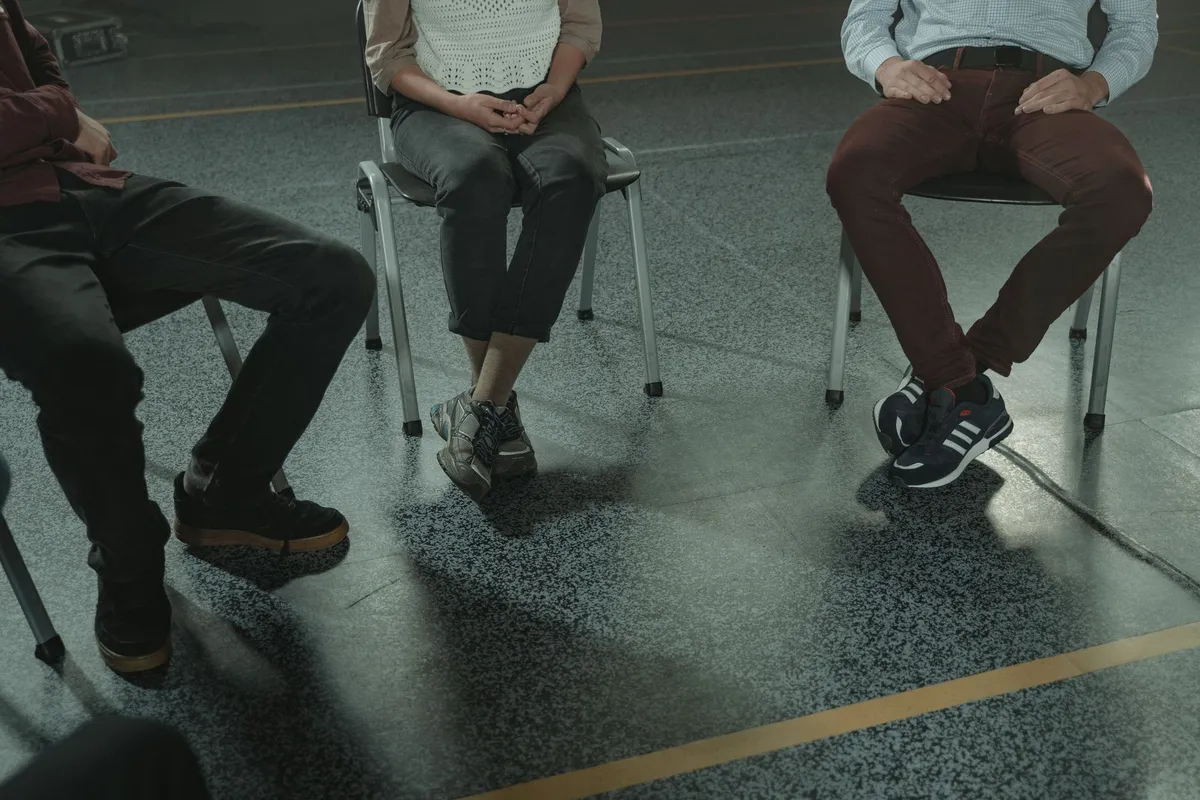
On the group, Tyler describes what one is actually for better than we can improve on. A safe landing spot: people who can do the thing you are trying to do, who will hold your stuff, meet you with empathy, and still push you to keep changing. Both halves matter. Soft enough to land on, firm enough that you do not just lie there. A group that only ever agrees with you is a waiting room.
Partners arrive expecting counseling to answer whether to stay. It does not do that, and any counselor who answers it for you has overstepped. What it builds instead is your capacity to hold a boundary, and there is a distinction inside that word which decides whether any of it works.
Brannon puts it plainly: boundaries come from power, control comes from fear, and only one of them is recovery. A real boundary is built from knowing your own values and stepping into them on purpose. It sounds like this: for me to be me, I need this. Trying to manage what was never yours to manage is the fear cycle wearing a boundary's clothes, and it will not bring you peace, because nobody feels grounded while gripping something that was never in their hands. Checking his phone six times a night is not a boundary. Deciding what you will and will not live with is.
Individual sessions run at normal therapy rates in your area, and specialist training tends to sit at the higher end. Insurance often covers it when billed under an anxiety, depression, or trauma diagnosis, which is usually accurate rather than a workaround. Partner groups typically cost a fraction of individual work, and peer-led partner meetings are free in most places and online everywhere.
If he refuses to get help, go anyway. This is the part partners resist hardest and it is the whole point of the trauma model: your injury is real whether or not he ever addresses his behavior, and it does not need his cooperation to be treated. What his refusal does give you is information, and the question of whether to trust him gets easier to answer once you stop trying to answer it alone. If he is willing but lost, what actually helps a man with a pornography problem is a separate track from yours, and it should stay separate for a while.
None of this is a fast process and we are not going to pretend otherwise. What changes early is not the pain, it is the isolation, and that turns out to be most of what makes the pain unbearable. If you want the longer version of the road itself, what healing from betrayal trauma actually involves covers it, and how to vet a betrayal trauma therapist covers the rest of the questions to ask.
Weekly groups online, and a three day retreat in Idaho. If there is a man in your life who is ready to start, the video walks through exactly what he would be walking into.