
cheating husband therapy
Cheating Husband Therapy: What Actually Helps, and in What Order
By Rising Son Team, Coach led men's program
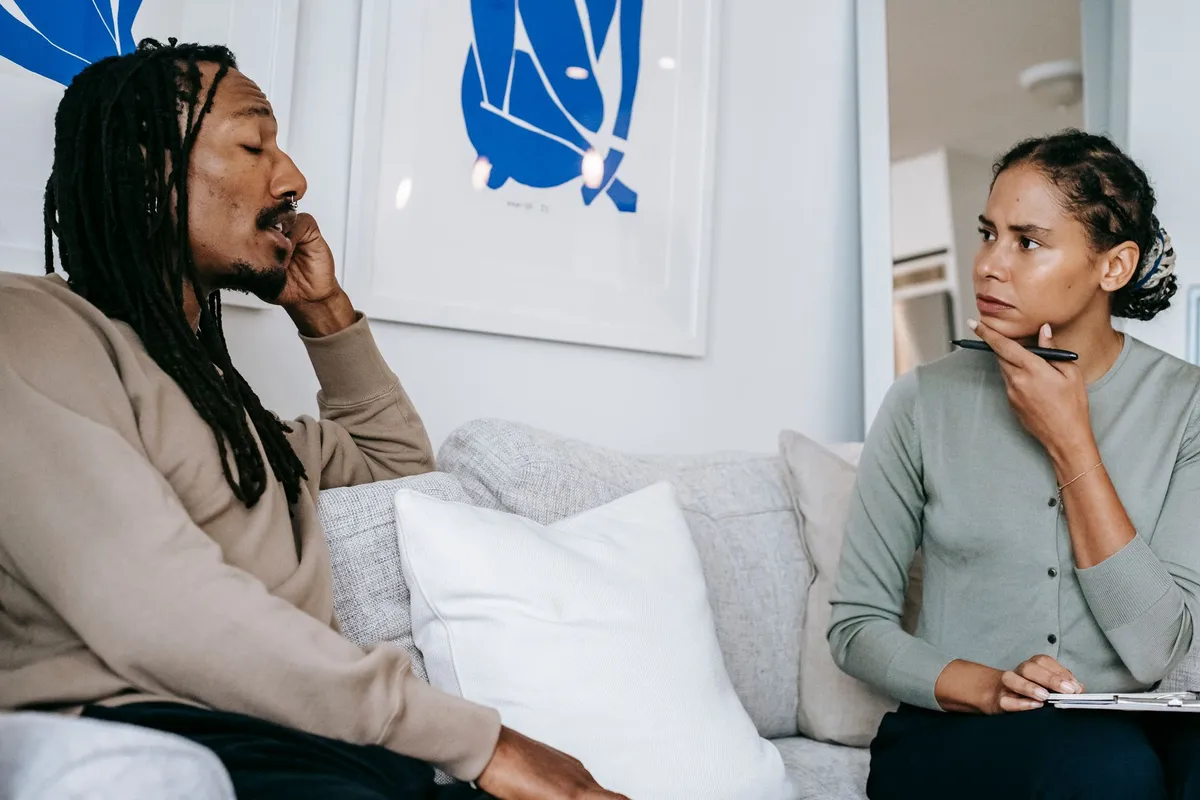
Photo by Alex Green on Pexels
Photo by Alex Green on Pexels
Cheating husband therapy can help, and plenty of couples come through infidelity more honest than they were before. But here is the part that matters more than the word therapy: the kind of help and the order you do it in decide almost everything. The same couple can go to counseling and either start healing or make the wound worse, depending on whether the man is actually doing his own work first or just performing in a room once a week. So the real question is not whether to get help. It is which help, in what sequence.
This is written for the person trying to figure out what to do next, usually the partner who was betrayed and is now researching therapists at 11pm, and it is just as useful for the man who knows he needs to change. It comes from two therapists who have run this work with men for years. We are going to be straight about what helps, what quietly backfires, and what to look for before you spend a year and a lot of money on the wrong thing.
Yes, therapy helps, but only when a few things are true, and no honest professional can promise you the outcome. What makes it work is not the technique. It is whether the man is genuinely willing to be honest, stop the behavior, and do the uncomfortable work, week after week, when it stops being new. If he shows up to tick a box and prove he is a good guy, the best therapist in the world cannot move it.
That is the piece most people miss when they search for a therapist. You are not shopping for a person who will fix your husband. You are looking for the right structure to support a change only he can make. We do not need him to be perfect. We need to see that he is proactive in his own recovery, not waiting to be dragged through it. If that willingness is there, therapy has something to build on. If it is not, no amount of counseling substitutes for it.
Here is the most useful thing in this article. Most couples rush straight into marriage counseling while the betrayal is still fresh and the man is still hiding, lying, or only half-out of the affair. That order backfires. Sitting a traumatized partner across from a man who is still not fully honest, and asking them to work on communication, can re-injure her and teach him to perform remorse instead of living it.
There is a better sequence, and it matches how good clinicians approach this. The Gottman Institute's Trust Revival Method puts it in order: first the affair ends completely and the truth comes out, then everyday trust and safety get rebuilt, and only later does the couple work on closeness. In plain terms:

Cheating husband therapy is not one thing. It is usually a few kinds of support doing different jobs, and knowing which does what keeps you from expecting one to do all of them.
If you want to understand that last one, we wrote about betrayal trauma in marriage and why the injury behaves like trauma and not just hurt feelings. Any good plan takes her wound as seriously as his behavior.
Here is our honest opinion, and it is the reason a lot of men stall for years in comfortable therapy. Gentle, hands-off support is fine, and it has a ceiling. A lot of men can sit in a soft weekly session, say the right things, feel briefly better, and change almost nothing, because nobody in the room will look them in the eye and call out the performance. What actually moves the thing, for many men, is direct, in-your-face feedback delivered through real respect and connection. Being told the truth, by people who have earned the right to say it, is often what finally cracks what years of polite advice did not.
This is not an argument against therapists. Good individual therapy is essential. It is an argument against mistaking a calm conversation for the whole job. A man cannot quietly think his way out of a pattern he built in secret. He needs honest company that will not let him perform, and that is why the group piece matters so much alongside the individual work.
Not all counseling is built for this, so choose with a few things in mind:
Longer than anyone wants, and there is no clean number. Clinicians who specialize in this often talk about a couple of years or more of steady work before deep trust feels solid again, with real improvement showing up well before that. How long it actually takes depends on the depth of the betrayal, whether he told the whole truth at once or kept feeding it out in pieces, and whether his changes hold when they get tested. Be wary of anyone who promises a timeline or guarantees the marriage. You cannot control his choices, only the structure and support around the work.
You do not have to wait a year to read the direction. It is working when he moves toward honesty on his own, volunteers hard truths instead of waiting to be caught, sits with her pain without rushing her, and keeps changing between sessions, not just during them. It is not working when he treats therapy as the punishment he is enduring, keeps his defensiveness up, learns better words but not better behavior, or quietly counts down to when he has done enough to be forgiven.
A common and honest pattern, and there is nothing shameful in it, is the partner who finds a program first and sends it to him. That is often how a man finally walks through a door he could not open alone. If he goes, watch what he does with it, because willingness is the whole tell.
Many marriages do recover, and some do not, and doing the work is the right move either way, because you cannot know your answer in advance and you cannot control his. What is worth naming is that the couples who make it are rarely the ones who went back to exactly how things were. They build something more honest than what existed before the affair, where the secrecy that made room for it is gone. Going back to normal is the wrong goal, because the old normal is part of what broke. The goal is a marriage with nothing hidden in it, which is a different and better thing than the one you had.
Be careful, too, with the pressure to declare the marriage saved on a schedule. Recovery is a process, not a decision you make once. Nobody runs an endurance race by deciding to one day, then calling it done. You follow the process, do the hard things consistently, and show up on the bad days, and you find out whether it holds by living it, not by promising it up front. That is as true for the marriage as it is for his individual work, and it is why patience is not a soft virtue here but a practical requirement.
Rising Son is the men's work part of this picture. Brannon Patrick and Tyler Patrick are licensed therapists and brothers, and they have run in-person work with men since 2017, mostly men between 35 and 55 rebuilding integrity after pornography, infidelity, and secrecy. Small groups, direct feedback given through real respect, and men who have stood exactly where your husband is standing. It is not a replacement for a good individual therapist or for couples work in its proper place. It is the honest brotherhood alongside them that keeps a man from hiding, which is the part that so often decides whether any of it holds.
If the trust that broke came from an affair, the slow daily work of how to rebuild trust after cheating sits right next to this, and getting professional support in place matters for both of you. The American Psychological Association is a level-headed place to start reading on where therapy fits. When he is ready to stop hiding and do the work, you can see who this work is for and reach out to one of us. You cannot do his work for him. You can make sure the help around it is the kind that actually works.
Weekly groups online, and a three day retreat in Idaho. If there is a man in your life who is ready to start, the video walks through exactly what he would be walking into.